Leadership Companion Series – Episode 4
Topic: Strategies for Entering Advanced Pharmaceutical Markets (US & Japan)
Date: 11-10-2024
Day: Friday
Time: 7:00 pm
Speaker - Dr. Sanjit Singh Lamba_Consultancy and Advisory, Trillyum Consulting
Attendees-
On 11th October 2024, a session was conducted on "Strategies for Entering Advanced Pharmaceutical Markets (US & Japan)" by Dr. Sanjit Singh Lamba, a consultant from Trillyum Consulting. Dr. Lamba began the session by discussing the nature of the pharmaceutical markets in the US and Japan, highlighting how Japan, in particular, is a more stringent regulatory environment. He then moved on to discuss the current scenario of the Indian pharmaceutical market, noting that India is the third-largest market by volume and the 14th largest by value. The Indian pharmaceutical industry has created 2.7 million jobs, and by 2024, it is expected to grow into a $65 billion USD market. Dr. Lamba emphasized India’s pivotal role in global healthcare, supplying 66% of the global vaccine demand, 37% of affordable AIDS treatments, and accounting for one of every three pills consumed in the US.
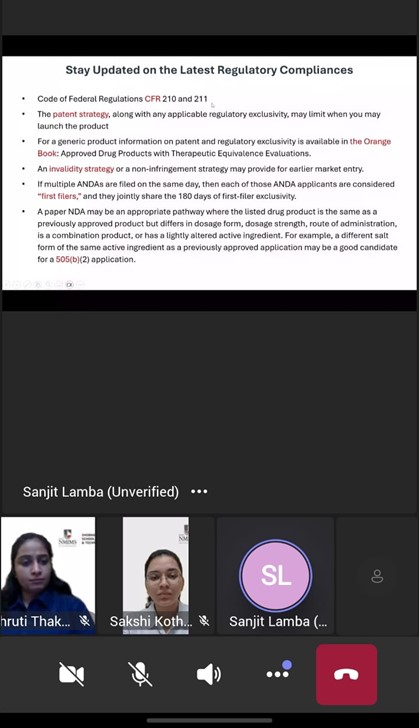
He provided an overview of the drug development and approval processes, explaining how innovator drugs require comprehensive development, whereas generic drugs need only regulatory approval. Dr. Lamba outlined key strategies for pharmaceutical exports, such as understanding the global market to identify opportunities, creating customized marketing strategies, staying updated with the latest regulatory compliance requirements, obtaining necessary certifications and licenses, ensuring intellectual property protection, and enhancing R&D efforts. He stressed that when identifying global opportunities, companies must evaluate the market landscape, including the total market size and competitor presence, while also considering their own technical capabilities. The focus should be on niche products, superior formulations, or better compliance to maintain competitiveness in a market where price wars often occur after the expiration of patents.
He also discussed the challenges of gaining approval for generic drugs in the US market. These challenges include patent disputes, the complexity of the Abbreviated New Drug Application (ANDA) process, the development of formulations under strict regulatory scrutiny such as the Quality by Design (QbD) approach, high GDUFA fees, and the severe price reductions that generics face post-launch, with prices dropping by up to 90% after the loss of exclusivity.
A comparison of regulatory procedures for pharmaceutical products between Japan, the USA, and Europe was also presented. In Japan, site accreditation is required, whereas in the USA and Europe, it is not. Japan mandates a GMP inspection for product-specific facilities, a requirement absent in the USA and Europe. Both Japan and Europe require fees, while in the USA, GDUFA fees are applicable. Regulatory procedures involve dossier submission to the PMDA in Japan, to the US FDA in the USA, and through National/MRP/DCP/CP routes in Europe. Japan necessitates master file registration, the USA requires DMF submission, and Europe does not mandate this. For validation, Japan requires three batches, the USA requires one, and Europe requires two. Finally, stability data for Japan and Europe must cover a minimum of six months, whereas the USA requires three months. This comparison highlighted the unique regulatory landscapes pharmaceutical companies must navigate across these regions.
During the Q&A session, Dr. Lamba addressed several key questions. When asked about due diligence in mergers and acquisitions, he explained that for innovator products, patent and financial diligence is essential, while for brand acquisitions, technical strengths should be the focus. On managing cross-functional teams in consultation projects, he emphasized the importance of capability, client management, team motivation, and time discipline. In response to a question on accelerated approvals for orphan or breakthrough drugs, Dr. Lamba confirmed that both the US and Japan offer expedited reviews, especially for critical drugs where no therapy currently exists. Finally, he addressed the challenges faced by Indian companies in Japan, noting that consistency in delivering high-quality products and building trust with Japanese stakeholders are crucial. He also highlighted cultural differences and the importance of adapting to Japan's communication style, particularly when managing both positive and negative news in business relationships.
Ms. Ketaki Apte concluded the session by appreciating Dr. Sanjit Singh Lamba for his in-depth insights into the pharmaceutical markets of the US and Japan, emphasizing the practical value of his strategies for industry professionals. She praised his clear explanations of complex regulatory frameworks and his advice on navigating global challenges. The fourth episode of the Leadership Companion Series was a resounding success, with over 260 participants engaging in the session.